“What’s the UK job market like?”
The August 2026 KPMG & REC UK REPORT ON JOBS has been published featuring survey results from mid/late July.
The full report is posted here
Callum Licence, Group Head of Advisory, KPMG UK and Switzerland commented:
“Despite ongoing uncertainty it’s encouraging that businesses are starting to press ahead with investment, which means across the board we are starting to see the data moving in the right direction. This is most pronounced in the continued rise of temporary work, where employers have been looking at flexible approaches and hiring has been growing for several months and permanent hiring is starting to turn a corner.”
Maxine Bligh, REC’s Chief Membership & Innovation Officer, said:
“Rays of light are beginning to break through for the job market as employers revive hiring plans. Remarkably, this is the first month without a decline in permanent placements since Liz Truss resigned as Prime Minister in 2022, underlining just how prolonged the downturn in permanent hiring has been.”
Key findings are:
- Permanent placements stabilise and temp billings rise for fourth straight month
- Temp vacancies rise for the first time in two years
- London’s growth in permanent placements fastest for nearly four years
- The availability of candidates to fill roles continued to increase in July, albeit at lower rate
- Rates of pay growth improve in July
- ONS figures indicate that the number of total job vacancies across the UK fell again in the three months to June.
- Nursing/Medical/Care sector register high demand for permanent staff with increases also in Engineering and IT
- The Retail and Hotel & Catering sectors yet again saw the steepest reductions in permanent vacancies.
Appointments
Permanent placements stabilise in July: temp billings rise for fourth month in a row

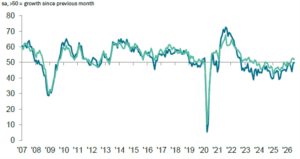
The latest survey showed that permanent recruitment levelled off at the start of the second half of 2026, bringing a 45-month run of falling appointments to an end. Recruiters reported that concerns about the political and economic environment, together with increased employment costs, continued to make many businesses cautious about expanding their permanent workforces. However, some employers moved forward with hiring as new projects got under way.
Permanent hiring strengthened in both London and the Midlands during July. London recorded particularly strong growth, with appointments rising at their fastest rate for almost four years. In contrast, permanent staff hiring continued to fall across the South and North of England.
Vacancies
Vacancies decline at slowest rate in 22 months

UK recruitment consultancies reported that the fall in overall demand for staff eased during July. The seasonally adjusted index increased from 45.1 in June to 47.1, indicating the smallest reduction in vacancies since September 2024. Nevertheless, the figure continued to point to a substantial contraction in demand and remained well below the survey’s historical pattern of strong vacancy growth.
Permanent and temporary vacancies
Demand for temporary workers increased in July for the first time in two years, according to the latest survey. Although the rise was relatively modest, it was the strongest recorded since August 2023.
Meanwhile, demand for permanent employees continued to decline, but the pace of contraction eased. While the fall in permanent vacancies remained substantial, it was the smallest recorded for 22 months.
Public and private sector vacancies
Sector data showed a solid increase in demand for temporary staff within the private sector during July, while the public sector recorded only a slight decline.
Demand for permanent employees continued to fall across both sectors, although the pace of decline eased. The reduction was less marked among private sector employers than in the public sector.
Vacancies by Sector
Permanent staff demand increased in three of the ten sectors surveyed, with Nursing/Medical/Care recording the strongest growth. In contrast, the largest falls in permanent vacancies were seen in Retail and Hotel & Catering.
Temporary staff demand rose across seven of the sectors surveyed in July, with Blue Collar and Engineering recording the strongest increases. Retail was the weakest-performing sector, registering the largest fall in demand for temporary workers.

ONS Data
Office for National Statistics date showed the number of job vacancies declined in the three months to June, according to the latest figures from the Office for National Statistics (ONS). Vacancies fell by 7,000 compared with the three months to March, taking the total to 712,000 – one of the lowest levels recorded over the past five years.
There were also 18,000 fewer vacancies than during the same period last year. The latest total was around 9.6% below the pre-pandemic level of 788,000 recorded in the three months to March 2020.

Staff availability
Candidate numbers continued to increase across the UK

The supply of candidates across the UK continued to grow in July, extending the current upward trend to 41 consecutive months. Although the increase remained strong, it was the weakest recorded since February. The seasonally adjusted index slipped from 60.1 in June to 59.8 but remained comfortably above the neutral 50.0 level.
The latest data also showed that the availability of both permanent and temporary candidates continued to rise during July, although growth slowed in both categories
The availability of permanent candidates rose sharply again in July, although the pace of growth eased for the second successive month to its lowest level in five months. Recruiters reported that redundancies and worries about job security had encouraged more people to look for permanent positions. Weak hiring demand and a shortage of job opportunities were also cited as factors contributing to the increased supply of candidates.
Permanent candidate availability increased across all regions of England. The strongest growth was recorded in the North of England, while London saw the slowest increase.
Survey participants reported that ongoing redundancies remained a significant factor behind the increase in candidate availability. In addition, more individuals were said to be exploring alternative employment opportunities due to concerns about the stability of their current roles.
Pay pressures
Starting salaries increase at quickest rate for six months
There was a further acceleration of permanent salary inflation during July. According to the latest data, starting salaries rose to the greatest extent since January and solidly overall. Pay has now increased in each month since March 2021, with recruiters often mentioning that employers were willing to raise salary offers to attract and secure candidates with the right skills and experience. The latest survey indicated that the strongest increase in salaries was seen in London, while the softest was in the South of England.
ONS Data
Latest data from the Office for National Statistics (ONS), is as usual a bit out of date. Growth in total employee earnings, including bonuses, slowed in the three months to May. The latest ONS figures showed that earnings across the economy increased by 4.3% year-on-year. This was the weakest growth since the three months to February, when the rate stood at 3.9%, and one of the lowest increases recorded since the pandemic.
The slowdown was driven by weaker pay growth in the private sector, where earnings rose by 4.0%, close to their lowest post-pandemic rate. This outweighed stronger growth in public sector earnings, which increased by 5.5% over the same period.

London job market
KPMG and REC also produce a London job market analysis.
Anna Purchas, London Office Senior Partner at KPMG UK, said:
“The headline for recruitment as we head through the summer is businesses are back hiring. While the geopolitical picture remains uncertain, things are settled enough for businesses to start taking a pragmatic approach to their hiring plans. London’s leading the charge, principally because of very concentrated demand in high growth sectors.”
Fresh rise in permanent placements
Permanent staff appointments in London increased during July, ending a two-month period of decline. Growth was strong and reached its highest level in almost four years. Recruiters attributed the improvement to greater demand for skilled candidates and increased recruitment activity across certain types of role.
Of the other English regions surveyed, the Midlands was the only one to report growth in permanent placements, although the increase there was marginal.
Job vacancies
London remained the only one of the four English regions surveyed to record an increase in permanent vacancies during July. Demand has now risen in each month since April, with the latest growth both solid and the strongest recorded since October 2022.
Temporary vacancies also continued to increase in London. July marked the third consecutive month of growth, with the rise accelerating to its fastest rate for three-and-a-half years.

Growth in permanent candidate availability recedes
The supply of permanent candidates in London continued to increase strongly in July, although the rate of growth slowed to its weakest for almost two-and-a-half years.
London also recorded the smallest increase in permanent candidate availability of the four English regions surveyed.
Recruiters in the capital largely attributed the continued rise in candidate supply to redundancies.
Starting salary growth accelerates significantly in July
Starting salaries for permanent employees in London rose sharply during July, with the rate of growth reaching a 16-month high. Salary inflation has now strengthened for four consecutive months. Recruiters attributed the increase to the recruitment of senior employees and employers offering higher salaries to secure candidates with the skills they required.
Starting salary growth in London was also considerably stronger than in the other three English regions surveyed.
Regional comparison
Staff appointments
Permanent staff appointments across the UK were unchanged overall in July, bringing a 45-month period of declining placements to an end. The improvement was driven by a strong return to growth in London and a slight increase in the Midlands. However, permanent hiring continued to fall in both the North and South of England, with the pace of decline accelerating slightly.
Temporary billings increased nationally for the fourth consecutive month in July, although growth slowed to its weakest rate since April and was only modest. Three of the four English regions surveyed reported higher temp billings, with the strongest increases seen in the North of England and London. The Midlands moved in the opposite direction, recording its first fall for a year, although the decline was marginal.
Candidate availability
The supply of permanent candidates across the UK increased again in July, marking the 41st consecutive month of growth. Although candidate availability continued to rise strongly, the pace slowed to its weakest since February. The North of England recorded the largest increase, while London saw the smallest.
Temporary candidate availability also rose sharply across the UK, although growth eased to its slowest rate since May 2023. All four English regions surveyed experienced a slowdown in the rate of increase. The South of England recorded the strongest growth in temporary staff supply, while the Midlands saw the weakest.
Pay pressures
Pay growth strengthened across the UK in July, with starting salaries for newly appointed permanent employees increasing at their fastest rate since January. Salaries rose across all four English regions surveyed, including a return to growth in the South of England. London recorded the strongest increase, where salary growth reached a 16-month high.
Temporary pay also increased more quickly during July. Wage growth accelerated across all four English regions, contributing to a solid rise nationally. The rate of UK temporary wage inflation was the strongest recorded since May 2024.


The Prism Executive Recruitment perspective: management consultancy recruitment
The Decline in the Management Consulting Job Market
The management consulting recruitment market has faced sustained difficulties since the latter part of 2022. From mid-2023, the Big Four and other leading consulting firms began announcing successive rounds of redundancies. This included strategy consultancies, which have traditionally proved more resilient during weaker markets. Meanwhile, many smaller consulting businesses have reduced their permanent workforces and scaled back their use of associates, often with considerably less publicity.
This has created a significant mismatch between the supply of experienced management consultants looking for new roles and the number of vacancies available. With relatively few opportunities in the market, consulting employers have been unable to accommodate the increasing number of unemployed consultants seeking their next position.
A succession of prominent announcements during 2024 and 2025 illustrated the difficult conditions facing the sector. In May 2024, reports emerged that “PwC asks for silence from departing staff in programme of UK job cuts,” as the firm undertook another substantial voluntary redundancy programme.
Further concerns emerged the following month, when it was reported that “Consultants to lose £3bn of UK government work under plan to halve advisory spend.”
In July 2024, the Financial Times reported that “UK consultant numbers shrink as companies cut back on external advice. Headcount fell 3% last year with firms axing jobs and moving staff as post-pandemic boom fades.”
Further redundancy announcements followed during the latter part of the year. October brought reports that “Deloitte axes 250 UK employees in performance-related cull.” Two months later, this was followed by the announcement that “Deloitte accelerates UK layoffs with fresh redundancy round.”
EY also outlined potential workforce reductions in December 2024, commenting that “Regrettably, proposals put forward in part of the UK consulting practice may result in a reduction of 150 roles”.
Challenging news continued during 2025. Notable September headlines included “PwC UK cuts jobs as revenue growth slows sharply” and “Deloitte UK’s revenues fall for first time in 15 years”. Earlier, in June, weakening client demand had been highlighted when “Accenture says CEOs are postponing hiring consultants due to uncertainty”.
There have, however, been some more positive indications during 2026, with headlines including:
“Consultancies set for fastest growth in years on back of AI boom”
“Consultants cash in on Europe’s defence pivot”
And, suggesting that AI may not result in a “jobs apocalypse” in the sector “Human skills ‘matter even more’ for early consultancy career roles”
Potential Reasons for the Downturn:
- Overly optimistic hiring and pay rises in 2022: consulting firms recruited heavily during 2022 and offered substantial salary increases, adding significantly to their cost bases. These decisions were based on expectations of continued growth that ultimately failed to materialise.
- Economic slowdown since: management consulting is particularly sensitive to changes in the wider economy. Even relatively modest economic weakness can cause employers to pause recruitment, with redundancies potentially following if demand remains subdued.
- Cautious re expansion: many consulting firms continue to trade reasonably well, but persistent uncertainty has discouraged them from making significant additions to permanent headcount.
- Sector growth subdued: a January 2026 survey of UK consulting leaders forecast sector growth of 5.7% for 2026, representing the weakest projected growth rate since 2020.
Other indicators
In related news a mixed picture again:
- The NatWest Business Growth Tracker from July says “UK businesses continued to project output growth over the coming 12 months, with confidence levels across both SMEs and mid-market firms improving from May. While optimism remained below long-run averages, easing cost pressures helped support a more positive outlook.”
- The S&P UK Services Purchasing Managers’ Index (PMI) from August 2026 states: “UK service sector returns to growth in July… data pointed to a modest turnaround in business activity across the service economy, supported by an expansion of new work for the first time since February”
- The S&P Global UK Manufacturing PMI also from August “Growth of UK manufacturing, production and new business gather pace in July. The start of the third quarter saw further positive signs emanating out of the UK manufacturing sector. Upturns in production, new business and new export orders all gained momentum, while the impact of the twin headwinds of high cost inflation and severe supply chain disruption eased further.
- The Lloyds Bank Business Barometer from July 2026 has as key highlights:
- UK business confidence in July rises 5 points to a four-month high of 49% as economic optimism rebounds
- Improvement in business sentiment led by smaller firms
- Trading prospects remain resilient, with firms’ expectations for future activity holding steady
- Employment expectations moderate as firms balance hiring plans with cost control and efficiency improvements
- Price-setting intentions continue to soften as cost pressures become less acute
- The IoD Directors’ Economic Confidence Index, from August, which measures business leader optimism over prospects for the UK economy, said “Our latest data signals a further modest deterioration in sentiment and trading conditions in July. Overall confidence in the economy has drifted down a little further amongst business leaders, continuing its trend of weakness and volatility since the 2024 Budget. Meanwhile revenue expectations have dropped to their weakest level in 2026, and alongside elevated costs, means the squeeze on margins has intensified. Business leaders report that consumer spending is under pressure from weak sentiment and price pressures, while demand generally remains cautious.”
- While the CIPD’s Spring 2026 Labour Market Outlook released in May states “this quarter’s data indicates a broadly stable jobs market, with marginally more positive recruitment activity in the public sector. Our data, collected across March and April, does not show any material impact of the recent conflict in Iran on our employment indicators; however, as with any geopolitical shock, it can take businesses a period of time to assess the potential impact on their operations.”
- The Page Group, very much an economic bellwether in professional and executive hiring, issued half year results in August 2026 stating “We saw continued growth in Asia Pacific and the Americas, as well as a return to growth in Q2 in Southern Europe. In total, c. 50% of the Group was in growth in H1. However, trading remained more challenging across France, Northern Europe and the UK.”
- BDO’s Employment Index a combination of hiring intentions, headcount and labour demand, held steady at 93.08, remaining close to its recent 15-year low. While hiring conditions remain subdued, this is the first month since May that the Index hasn’t declined, offering hope that stabilisation is on the horizon.
- The comprehensive Adzuna UK Job Market Report stated “UK job vacancies rose for a fourth consecutive month in May, climbing +2.85% to 799,737. The sustained run of growth – the first since the downturn began in mid-2025 – has narrowed the annual decline from -16.1% in January to just -6.84% in May, the smallest gap recorded since vacancies began falling.”
- The REC’s Labour Market Tracker, which reviews job postings, updated in July 2026, shows a level broadly unchanged since September 2024 albeit with encouraging signs in 2026.

- The most recent quarterly ManpowerGroup Employment Outlook Survey , released in June on, predicting the state of the labour market globally for Q3 2026, puts the UK well above average with regard to hiring expectations.
Methodology
The KPMG and REC UK Report on Jobs is compiled by S&P Global from responses to questionnaires sent to a panel of around 400 UK recruitment and employment consultancies.
For more information on the job market, or to discuss your hiring or career plans please contact Chris Sale, Managing Director, Prism Executive Recruitment via [email protected]